I've been tagged by Do What I Like
Five facts about Me:
....I'm going to let my visitors decide what they would like to know about me. So here's your chance! Post your questions about me as a comment below and I will answer the first 5.
First Question:
Oh goody... I get to post a question... Let´s see.. Hmm... oh yes, i have one. How come I no longer see u in NK?! :)
>>The truth is I don't like you! Just kidding! ;P I've just been busy 'adjusting' to things. As you probably know, I recently graduated, traveled, then started culinary school. But everything is finally falling into its place, I'll be back in NK soon. :)
Question 2:
How old am I?
>>old enough.....:D I'm 22.
Question 3:
Who has been eating all the good stuff that you've been churning out?
>>They go to family and friends and sometimes...the trash can.
Question 4:
Do you ever consider become a TV chef or open your own catering business/ restaurants? Food network is dumped with French and Intalian cusine, and their food is not as attractive (to me) as ones you bring to the table.
>>Me? a TV chef? Honestly, I can't say that I haven't thought about it. BUT I think the chances are pretty low. Mainly because my philosophy/style in the kitchen is very low key, low profile. It seems like America is thirsty for seeing Vietnamese food or "Asian" food (whatever that is) as something that's sacred, complex and mystical. I have yet to see any Vietnamese cookbook written in english that isn't cashing in on that thirst by sugar coating and glorifying everything. I just can't do that and since I can't do that. I probably won't sell very well thus probably will never make it onto TV...which is fine for me since my passion is to be in the kitchen anyways. ;)
Question 5:
where do you get the original recipe from? What the average attempts for the food?
>>I get recipes the same way people have been getting for thousands of years. I learn from my elders, most of my recipes start out as ones passed down to me from my family, and family friends. I discovered cooking has become a lost art and most people are more than happy to pass down a traditional family recipe just for the sake of keeping it alive. It usually takes me about 2 tries (but sometimes up to 20) to get satisfactory results from a recipe.
The Meme rules:
1. Link to your tagger and post these rules.
2. Share 5 facts about yourself.
3. Tag 5 people at the end of your post and list their names (linking to them).
4. Let them know they've been tagged by leaving a comment at their blogs.
Five bloggers I would like to tag:
Yochana's Cake Delight
Food Lover's Journey
Foodcrazee
play-play in the kitchen
precious moments
Sunday, February 24, 2008

Monday, February 11, 2008
Friendship Ball
 I was given this from Edith and Jadepearl. Thanks for thinking of me! I am truly honored.
Friendship is always worth more if you pass it on, thus, I would like to to pass this ball on to:
Lily's Wai Sek Hong
East meets West
Pusiva's Culinary Studio
The Budding Cook
Zu's Kitchen
Yochana's Cake Delight
Cheers!
Saturday, December 29, 2007
Coconut and Raspberry Cake

For the Cake:
-100g unsalted butter
-170g sugar
-150g cake flour
-3 eggs (150g)
-120g milk
-1 tsp baking powder
*Cream butter and sugar until fluffy, add eggs 1 at a time, add milk. Sift in flour and baking powder, fold together. Bake at 350'f for about 30-35 mins.
Icing:
-400g whipping cream
-1 tbs powdered sugar
-1 1/2 tsp whipped cream stabilizer
*Whip cream and stabilizer in a bowl until soft peaks, add sugar and whip until stiff peaks.
Raspberry Filling:
-raspberry
-sugar
*simmer raspberries and sugar (to taste) in a sauce pan until mixture reduces to 3/4 its original volume.
The Fun Part:
Level the cake and cut into layers, add filling, frost, and cover with coconut.
Wednesday, December 19, 2007
A Taste of Gotanda
I’ve been meaning to post this for quite awhile. It’s my research project that I did close to a year ago for my drama 476 class. If you’re a frequent visitor you probably already know that I'm a recent graduate of UW, majoring in Drama. Instead of writing a boring paper, I decided to go with the creative project option. So here it is, my creative research project on Phil Gotanda and his works…for your pleasure :D.
Method:
1) To make the dressing, simmer together sugar, water, soy sauce and ginger for 5 mins., add vinegar and sesame oil. Cool before using.
2) Toss together shredded papaya, soy nuts, nori, and dressing.
3) Arrange salad on a plate with spiced tofu. Garnish with basil and sesame seeds.
In Ballad of Yachiyo, Yachiyo Matsumoto a young beautiful Japanese American girl, dreams of escaping her life inKauai and merging into American society. Her father encourages her to dream and reach for her dreams while her mother wishes to for her to be trained in traditional tea ceremony so that she can marry a good husband and live a low profile life. Yachiyo is sent off to live with Okusan to learn the tea ceremony. Yachiyo eventually falls in love with Okusan’s husband and gets pregnant. Okusan’s husband, Takamura refuses Yachiyo after she is pregnant. Yochiyo returns home and commits suicide by consuming ant poison.

Yachiyo is like Jane Eyre in many ways. She is calm on the outside, but her heart is fueled by passion. She also carries the desire to step out of traditional Japanese expectations. In this dish, chocolate mousse is a symbol for the passion inside Yachiyo. The mousse is hidden inside a shell of green tea rice pudding. The pudding reflects the soft and elegant ways Yachiyo acquired trough the tea ceremony and how it covers up her deep desires. The water lily, similar to but below the status of a lotus, stands for her gracefulness and purity.
Pudding:
1) Over double-boiler mix together cheese, milk and butter until homogenized, cool and add egg yolks
2) Fold flour until cheese mixture.
3) Beat egg whites until frothy, add cream of tartar and salt and beat till soft peaks. Add sugar and beat till stiff peaks.
4) Fold egg whites into cheese and flour mixture.
5) Bake in a preheated over at 350’f until golden.
6) When the cake is cooked, remove from oven immediately bang it on a hard surface (it’ll make the cake easier to remove later). Then invert the cake to cool. Remove the cake from the cake pan when it is completely cool.
Chang, Lia. "Philip Gotanda Revealed." Asian Connections. 17 Nov. 2002. Feb.-Mar. 2007 <http://www.asianconnections.com/a/?article_id=36>.
An interview with Gotanda about his motivation for his plays and how much improvement has in American society regarding the status and stereotypes associated with Asian Americans. Gotanda feels America
Gotanda, Philip Kan. Ballad of Yachiyo.New York
This moving play is Gotanda’s based on the story of Gotanda’s aunt, Yachiyo. Gotanda explains in the introduction that the story is part fiction and part non-fiction as his family considered Yachiyo’s past an embarrassment to the family and thus never talked about.
Gotanda, Philip Kan. Fish Head Soup and Other Plays.Seattle : University of Washington
This collection of plays includes Fish Head Soup, Yankee Dawg You Die, TheWash
Philip Kan Gotanda Official Site. 2005. Feb.-Mar. 2007
<http://www.philipkangotanda.com/index.shtml>.
Phil Gotanda’s official site. It has a short bio on him but his up coming projects. However, the site hasn’t been updated since 2005 so some of the information is not so useful.
Rich, Frank. "2 Asians andHollywood
A review of Yankee Dawg You Die. Rich praises the play especially the ending when past (Vincent) and future (Bradley) work together and learn from each other.
Sommer, Elyse. "Ballad of Yachiyo, A Curtainup Review." Curtain Up. 1997. Feb.-Mar. 2007 <http://www.curtainup.com/ballad.htm>.
A theater review of Ballard of Yachiyo. Sommer applauds Gotanda’s style of writing and ability to tie together past and present.
Approximately 20 weeks ago I accidentally stumbled into the works of Philip Kan Gotanda while searching for a monologue for a class. After skimming trough a few of his plays I became infatuated with his style of writing and the deepness that they carry. Gotanda’s ability to balance on the thin line between tradition and progress amazed me the most. For that reason, I decided to look deeper into his works.
Gotanda is a third generation Japanese American and the youngest of three children. He comes from a well educated family, the child of a doctor and school teacher. His family would be considered a part of the privilege class but, sadly their skin color did not grant them the high status. Having personally experience the rough side of life, Gotanda uses his past experiences to change the future. His plays deal with Asian American identity and stereotypes and how society encourages and feeds the monster. He allows the audience to navigate the bridge between his forbears perspective and his own as a Japanese-American (Sommer). He encourages change via self awakening, pride and acceptance. The battles that feed the Asian American revolution are in the plays themselves, in the sense that he is revealing and familiarizing mainstreamAmerica
I decided to employ my passion for cooking to reflect characters in Gotanda’s plays. The idea is to translate Gotanda’s message into a medium other than the stage. By offering his ideas in different mediums the public exposure rate is much higher and thus the revolution climbs higher towards success.
In Fish Head Soup, Mat Iwasaki a budding actor, fakes his death to run away and become an actor. He returns home to convince his family that his career is really taking off and asks them for financial help to produce his own movie. Mat is portrayed as more Americanized than the rest of his family. Mat recalls the painful memory of the when his dad took him downtown and they were harassed for being Asian. It was the turning point in his life, which provoked him into deciding to act White in an effort to try to fit in. However, when he returns home he rediscovers himself and realizes life is not that easy. We learn that his acting career did not really take off; he became a porn star.

This Dish is dedicated to reflect Mat. The Sashimi represents his heritage. The toasted bread crumbs rolled inside the sashimi represents the sashimi's desires to become fish sticks which is a metaphor for Mat’s desires to be white. The dish is served with both tartar sauce and wasabi to symbolize Mat’s choice of identity.
Ingredients:
-1/4lb fresh snapper or mahi mahi filleted
-1/2 cup panko bread crumbs
-2 tbs toasted pine nuts, crushed
-2 green onions, blanched and cut into 3” pieces
-wasabi and tartar sauce
Method:
1) Buy the freshest fish possible, and slice fillets into thin slices.
2) Toast bread crumbs and pine nuts until golden.
3) Sprinkle bread crumb mixture onto sliced fish, roll into finger size rolls. Tie the roll together with the blanched onion.
In Yankee Dawg You Die, Bradley a young actor is ready to change howAmerica

Tofu is often labeled as flavorless, and thus is usually employed in the culinary world as a medium to carry whatever flavors one desires, suppressing the tofu’s unique taste. Similar to the way Bradley feelsHollywood employs Asian actors to play stereotypical roles which cover up the true identity of Asian Americans. This dish represents Bradley’s critique and his effort in changing traditional views. Tofu is the center of the dish; it stands for the Asian American actor. The nori (roasted seaweed), and spices represent Asian heritage and they are used to enhance the delicate yet unique flavor of tofu.
Ingredients:
Method:
1) Cut tofu into small pieces, and size will do.
2) Mix together, sesame seeds, 5 spice powder, salt, bread crumbs, and garlic salt.
3) Dip tofu pieces into egg white, and roll them in the spices to coat evenly.
4) Deep fry the tofu until golden. Serve warm with nori.
In Yankee Dawg You Die, Vincent is first portrayed as one who accepts the labelsAmerica

This salad represents Vincent journey as an Asian Actor. The spiced tofu and nori are the same as in the previous dish to represent the Bradley that Vincent once was. The salad that accompanies the tofu is a metaphor choices Vincent decided upon in his journey. For example, Ginger and Sesame are strong flavors and can easily envelop the flavor of the tofu. They are present in the salad to represent Vincent’s choice of accepting stereotypical Asian roles which holds the potential to engulf true Asian identity. However, the salad goes with the tofu; the tofu is still the center of the dish. The dressing which seeks to conquer the tofu is unsuccessful and is forced to embrace the tofu making its true flavor ever more desirable. This corresponds to Vincent’s choices their reflection in him.
Ingredients:
Gotanda is a third generation Japanese American and the youngest of three children. He comes from a well educated family, the child of a doctor and school teacher. His family would be considered a part of the privilege class but, sadly their skin color did not grant them the high status. Having personally experience the rough side of life, Gotanda uses his past experiences to change the future. His plays deal with Asian American identity and stereotypes and how society encourages and feeds the monster. He allows the audience to navigate the bridge between his forbears perspective and his own as a Japanese-American (Sommer). He encourages change via self awakening, pride and acceptance. The battles that feed the Asian American revolution are in the plays themselves, in the sense that he is revealing and familiarizing mainstream
I decided to employ my passion for cooking to reflect characters in Gotanda’s plays. The idea is to translate Gotanda’s message into a medium other than the stage. By offering his ideas in different mediums the public exposure rate is much higher and thus the revolution climbs higher towards success.
Sashimi Wannabe Fish Sticks
In Fish Head Soup, Mat Iwasaki a budding actor, fakes his death to run away and become an actor. He returns home to convince his family that his career is really taking off and asks them for financial help to produce his own movie. Mat is portrayed as more Americanized than the rest of his family. Mat recalls the painful memory of the when his dad took him downtown and they were harassed for being Asian. It was the turning point in his life, which provoked him into deciding to act White in an effort to try to fit in. However, when he returns home he rediscovers himself and realizes life is not that easy. We learn that his acting career did not really take off; he became a porn star.

This Dish is dedicated to reflect Mat. The Sashimi represents his heritage. The toasted bread crumbs rolled inside the sashimi represents the sashimi's desires to become fish sticks which is a metaphor for Mat’s desires to be white. The dish is served with both tartar sauce and wasabi to symbolize Mat’s choice of identity.
Ingredients:
-1/4lb fresh snapper or mahi mahi filleted
-1/2 cup panko bread crumbs
-2 tbs toasted pine nuts, crushed
-2 green onions, blanched and cut into 3” pieces
-wasabi and tartar sauce
Method:
1) Buy the freshest fish possible, and slice fillets into thin slices.
2) Toast bread crumbs and pine nuts until golden.
3) Sprinkle bread crumb mixture onto sliced fish, roll into finger size rolls. Tie the roll together with the blanched onion.
Spiced Tofu with Nori
In Yankee Dawg You Die, Bradley a young actor is ready to change how

Tofu is often labeled as flavorless, and thus is usually employed in the culinary world as a medium to carry whatever flavors one desires, suppressing the tofu’s unique taste. Similar to the way Bradley feels
Ingredients:
-1 block firm tofu (1lb)
-nori (roasted seaweed)
-2 tbs sesame seeds
-1 pinch 5 spice powder
-1/2 tsp salt
-1 tbs panko bread crumbs
-dash of garlic salt
-1 egg white
-oil for frying
-nori (roasted seaweed)
-2 tbs sesame seeds
-1 pinch 5 spice powder
-1/2 tsp salt
-1 tbs panko bread crumbs
-dash of garlic salt
-1 egg white
-oil for frying
Method:
1) Cut tofu into small pieces, and size will do.
2) Mix together, sesame seeds, 5 spice powder, salt, bread crumbs, and garlic salt.
3) Dip tofu pieces into egg white, and roll them in the spices to coat evenly.
4) Deep fry the tofu until golden. Serve warm with nori.
Green Papaya Salad with Spiced Nori Tofu and Ginger Sesame Dressing
In Yankee Dawg You Die, Vincent is first portrayed as one who accepts the labels

This salad represents Vincent journey as an Asian Actor. The spiced tofu and nori are the same as in the previous dish to represent the Bradley that Vincent once was. The salad that accompanies the tofu is a metaphor choices Vincent decided upon in his journey. For example, Ginger and Sesame are strong flavors and can easily envelop the flavor of the tofu. They are present in the salad to represent Vincent’s choice of accepting stereotypical Asian roles which holds the potential to engulf true Asian identity. However, the salad goes with the tofu; the tofu is still the center of the dish. The dressing which seeks to conquer the tofu is unsuccessful and is forced to embrace the tofu making its true flavor ever more desirable. This corresponds to Vincent’s choices their reflection in him.
Ingredients:
-1 small green papaya, approx. 1 lb, peeled, and shredded
-Spiced Tofu and Nori (from previous recipe)
-soy nuts (available at health food stores)
-3tbs soy sauce
-3 tbs sugar
-3 tbs water
-2 tbs rice wine vinegar
-2” piece of ginger, crushed
-1/2 tsp sesame oil
-Spiced Tofu and Nori (from previous recipe)
-soy nuts (available at health food stores)
-3tbs soy sauce
-3 tbs sugar
-3 tbs water
-2 tbs rice wine vinegar
-2” piece of ginger, crushed
-1/2 tsp sesame oil
Method:
1) To make the dressing, simmer together sugar, water, soy sauce and ginger for 5 mins., add vinegar and sesame oil. Cool before using.
2) Toss together shredded papaya, soy nuts, nori, and dressing.
3) Arrange salad on a plate with spiced tofu. Garnish with basil and sesame seeds.
Green Tea Rice Pudding with Chocolate Mousse and Kumquat Infused Water Lily Petals
In Ballad of Yachiyo, Yachiyo Matsumoto a young beautiful Japanese American girl, dreams of escaping her life in

Yachiyo is like Jane Eyre in many ways. She is calm on the outside, but her heart is fueled by passion. She also carries the desire to step out of traditional Japanese expectations. In this dish, chocolate mousse is a symbol for the passion inside Yachiyo. The mousse is hidden inside a shell of green tea rice pudding. The pudding reflects the soft and elegant ways Yachiyo acquired trough the tea ceremony and how it covers up her deep desires. The water lily, similar to but below the status of a lotus, stands for her gracefulness and purity.
Pudding:
-1/2 cup cooked white rice
-3/4 cup water
-1/2 -3/4 cups milk or cream
-1 tbs green tea
-sugar to taste
-3/4 cup water
-1/2 -3/4 cups milk or cream
-1 tbs green tea
-sugar to taste
Method:
1) Steep tea in water for 5 mins. Remove and discard tea.
2) Blend together in a blender, tea and rice.
3) Simmer rice and tea mixture over medium heat for about ½ hour.
4) Slowly stir in sugar and cream until pudding desired consistency
5) Refrigerate until set
Chocolate Mousse:
-1/4 cup bittersweet chocolate chips
-1/4 cup milk
-3/4 cup whipping cream
-1 packet gelatin or 1 tbs whipped cream stabilizer
-1/4 cup powdered sugar
Method:
1) Nuke chocolate and milk in a microwave safe bowl for 30 seconds. Stir and nuke for another 30 seconds or until mixture is melted and homogenized. Cool to room temperature.
2) In a cold bowl whip together cream and gelatin (dissolved in 2 tbs hot water) or whipped cream stabilizer until soft peaks. Slowly add sugar and whip until stiff peaks.
3) Fold whipped cream into chocolate. Pour mixture into a cake pan. Refrigerate until set.
Kumquat infused Lily Petals:
-1/4 cup dried lily petals (aka lily bulb, can be purchased at well stocked Chinese grocery stores)
-3 kumquats, minced
Method:
1) wash lily petals and soak in hot water for ½ hour.
2) boil together lily petals and kumquats until tender, about 20 mins.
Final Presentation:
1) Smear a small amount of pudding onto a plate.
2) Carefully scoop chocolate mousse and place it on the pudding.
3) Cover the mousse with more pudding and garnish with the lily petals.
This recipe is dedicated to Okusan. She is in many ways like Yachiyo, she is passionate and is scared by love. Okusan differs from Yachiyo in that she prefers to allow tradition cover up her true self. The lotus seeds represent her gracefulness, endurance, and purity. The mangos stand for the sweetness and exoticness that is present in her love towards Takamura. The jasmine tea symbolizes how she drowns all of this in being formal, timid and traditional; the tea ceremony.

Ingredients:
-Jasmine tea
-sugar to taste
-1 ripe mango
-1/2 cup lotus seeds
-1 tsp baking soda
Method:
1) Soak lotus seeds overnight in solution of baking soda and enough water to cover the seeds by 2 inches.
2) Next morning, wash the seeds and boil until tender.
3) Steep tea according to package instructions, add sugar to taste.
4) Peel and dice mango.
5) Mix everything together and serve chilled.
C herry Blossoms is another word for the sexualization of Asian women. This topic comes up many times in Gotanda’s plays. It seems to one of his goals to break the habit sexualizing Asian women. Asian women are usually stereotyped as exotic and submissive.

In Fish Head Soup, we learn that Dorothy is a “cherry blossom”. Dorothy, Yachiyo, and Okusan all in way, appear to be cherry blossoms. However, this stereotype is always crushed by the end of the plays. The characters prove to the audience that they are like any other American women. The only difference is the color of their skin which causes society to label them as a cherry blossom. This cake is a modification of traditional Kasutera, Japanese sponge cake. Japanese sponge cake is just like any other sponge cake, parallel to Asian women are like any other women. But the cake’s assigned name, Kasutera like the color of one’s skin forces society to label and assume differently. The message is, the more we familiarize ourselves with something considered different the more we learn that there are no differences. We are all the same at heart. There are no more cherry blossoms as cherry blossoms are no different than the blossom of a rose.
Ingredients:
1) Steep tea in water for 5 mins. Remove and discard tea.
2) Blend together in a blender, tea and rice.
3) Simmer rice and tea mixture over medium heat for about ½ hour.
4) Slowly stir in sugar and cream until pudding desired consistency
5) Refrigerate until set
Chocolate Mousse:
-1/4 cup bittersweet chocolate chips
-1/4 cup milk
-3/4 cup whipping cream
-1 packet gelatin or 1 tbs whipped cream stabilizer
-1/4 cup powdered sugar
Method:
1) Nuke chocolate and milk in a microwave safe bowl for 30 seconds. Stir and nuke for another 30 seconds or until mixture is melted and homogenized. Cool to room temperature.
2) In a cold bowl whip together cream and gelatin (dissolved in 2 tbs hot water) or whipped cream stabilizer until soft peaks. Slowly add sugar and whip until stiff peaks.
3) Fold whipped cream into chocolate. Pour mixture into a cake pan. Refrigerate until set.
Kumquat infused Lily Petals:
-1/4 cup dried lily petals (aka lily bulb, can be purchased at well stocked Chinese grocery stores)
-3 kumquats, minced
Method:
1) wash lily petals and soak in hot water for ½ hour.
2) boil together lily petals and kumquats until tender, about 20 mins.
Final Presentation:
1) Smear a small amount of pudding onto a plate.
2) Carefully scoop chocolate mousse and place it on the pudding.
3) Cover the mousse with more pudding and garnish with the lily petals.
Chilled Jasmine Tea with Mangos and Lotus Seeds
This recipe is dedicated to Okusan. She is in many ways like Yachiyo, she is passionate and is scared by love. Okusan differs from Yachiyo in that she prefers to allow tradition cover up her true self. The lotus seeds represent her gracefulness, endurance, and purity. The mangos stand for the sweetness and exoticness that is present in her love towards Takamura. The jasmine tea symbolizes how she drowns all of this in being formal, timid and traditional; the tea ceremony.

Ingredients:
-Jasmine tea
-sugar to taste
-1 ripe mango
-1/2 cup lotus seeds
-1 tsp baking soda
Method:
1) Soak lotus seeds overnight in solution of baking soda and enough water to cover the seeds by 2 inches.
2) Next morning, wash the seeds and boil until tender.
3) Steep tea according to package instructions, add sugar to taste.
4) Peel and dice mango.
5) Mix everything together and serve chilled.
No More Cherry Blossoms Kasutera
C herry Blossoms is another word for the sexualization of Asian women. This topic comes up many times in Gotanda’s plays. It seems to one of his goals to break the habit sexualizing Asian women. Asian women are usually stereotyped as exotic and submissive.

In Fish Head Soup, we learn that Dorothy is a “cherry blossom”. Dorothy, Yachiyo, and Okusan all in way, appear to be cherry blossoms. However, this stereotype is always crushed by the end of the plays. The characters prove to the audience that they are like any other American women. The only difference is the color of their skin which causes society to label them as a cherry blossom. This cake is a modification of traditional Kasutera, Japanese sponge cake. Japanese sponge cake is just like any other sponge cake, parallel to Asian women are like any other women. But the cake’s assigned name, Kasutera like the color of one’s skin forces society to label and assume differently. The message is, the more we familiarize ourselves with something considered different the more we learn that there are no differences. We are all the same at heart. There are no more cherry blossoms as cherry blossoms are no different than the blossom of a rose.
Ingredients:
-100g milk
-100g cream cheese
-50g butter
-150g Cake flour
-4 Large eggs, separated
-100g sugar
-pinch of salt
-1/8 tsp cream of tartar
Method:-100g cream cheese
-50g butter
-150g Cake flour
-4 Large eggs, separated
-100g sugar
-pinch of salt
-1/8 tsp cream of tartar
1) Over double-boiler mix together cheese, milk and butter until homogenized, cool and add egg yolks
2) Fold flour until cheese mixture.
3) Beat egg whites until frothy, add cream of tartar and salt and beat till soft peaks. Add sugar and beat till stiff peaks.
4) Fold egg whites into cheese and flour mixture.
5) Bake in a preheated over at 350’f until golden.
6) When the cake is cooked, remove from oven immediately bang it on a hard surface (it’ll make the cake easier to remove later). Then invert the cake to cool. Remove the cake from the cake pan when it is completely cool.
Works Cited
Chang, Lia. "Philip Gotanda Revealed." Asian Connections. 17 Nov. 2002. Feb.-Mar. 2007 <http://www.asianconnections.com/a/?article_id=36>.
An interview with Gotanda about his motivation for his plays and how much improvement has in American society regarding the status and stereotypes associated with Asian Americans. Gotanda feels
Gotanda, Philip Kan. Ballad of Yachiyo.
This moving play is Gotanda’s based on the story of Gotanda’s aunt, Yachiyo. Gotanda explains in the introduction that the story is part fiction and part non-fiction as his family considered Yachiyo’s past an embarrassment to the family and thus never talked about.
Gotanda, Philip Kan. Fish Head Soup and Other Plays.
This collection of plays includes Fish Head Soup, Yankee Dawg You Die, The
Philip Kan Gotanda Official Site. 2005. Feb.-Mar. 2007
<http://www.philipkangotanda.com/index.shtml>.
Phil Gotanda’s official site. It has a short bio on him but his up coming projects. However, the site hasn’t been updated since 2005 so some of the information is not so useful.
Rich, Frank. "2 Asians and
A review of Yankee Dawg You Die. Rich praises the play especially the ending when past (Vincent) and future (Bradley) work together and learn from each other.
Sommer, Elyse. "Ballad of Yachiyo, A Curtainup Review." Curtain Up. 1997. Feb.-Mar. 2007 <http://www.curtainup.com/ballad.htm>.
A theater review of Ballard of Yachiyo. Sommer applauds Gotanda’s style of writing and ability to tie together past and present.
Wednesday, December 12, 2007
Eating off the Streets - Malaysian Street Food

Food is everywhere! My first stop while in Malaysia's Chinatown was this jerky stand. These goodies are made from ground meat + spices, flattened, dried and then grilled. They are absolutely to die for!

Next up....Satay, another must eat to add to the list for anyone visiting M'asia. Your choice of chicken or beef, deliciously prepared and served with fresh slices of cucumber, onions and their dipping sauce. They're a bit greasy, probably from coconut milk but who cares!?! They're too good to pass.

What is this? I dunno, but it tastes good. It's cendol in a bright pink, sweet, milky liquid. I know what you're thinking...yes, it does look like Pepto Bismol.
I have this thing for bright colors and instead of shying away from eating brightly colored foods I actually go after them. This drink caught my eye and I just had to have a taste. I has a unique pleasant flavor.... Perfect for a hot day and to wash down the satay and jerky.
Hats off to you Malaysia, your food is delicious and your people are wonderful!
Friday, November 16, 2007
Putu Bambu - Past vs. Present
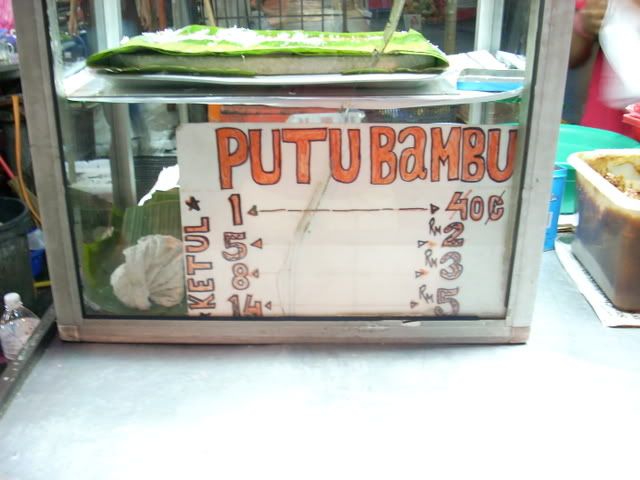
To my friends from Malaysia, I have a question for you, putu bambu means bamboo cake...right?
I discovered these treats while visiting the night market in Chow Kit. Funny story, apparently Chow Kit is the redlight district of Kuala Lumpur, but I had no idea. I actually didn’t find this out until the day before my scheduled return to
Back to the main story. I was walking around the night market which is just a few blocks from my hotel. The cakes are so unique I had to stop for a taste even though I already stuffed from eating Satay earlier (more on that later).
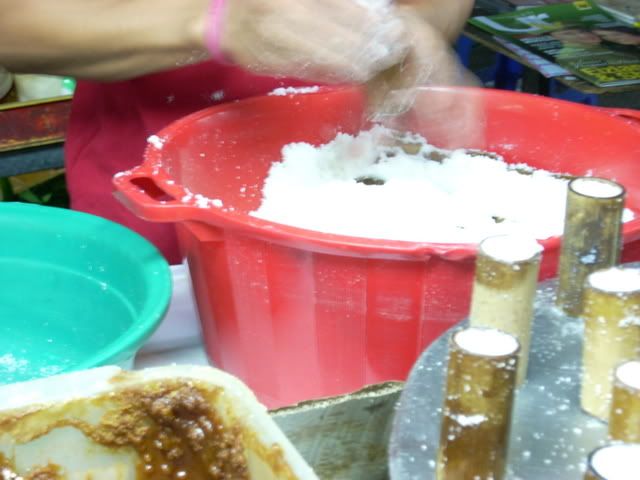
The cakes are made from what looks to be coarsely ground rice. Bamboo molds are stuffed half full with the rice. Palm sugar is added and then more rice.

The Cakes are steamed for a few mins.

The finished product is a soft, tender, slightly spongy cake. It’s served with grated coconut, and a spoon full of palm sugar.
It goes to show, sometimes the simplest ingredients can become the tastiest creations. So forget the dough improvers, dough softeners, and sponge gel/stabilizers, stick with tradition!...It's yummy! :p
Tuesday, November 13, 2007
Eye on Malaysia
Malaysia, Malaysia, Malaysia.....wow, what a country! This year happens to be Malaysia's 50th independence anniversary, and there's so much celebrating on. Eye on Malaysia being a year long party is my first stop while visiting. They have a pretty impressive light show at night...see for yourself.

Not sure what these are called but they're sooo good. Can't resist must have a taste and snap a picture.
My most favorite are the green mangoes and the chayote. The perfect balance of sweet and sour with a crunchy texture. They're perfect to much on while watching the show.
Subscribe to:
Posts (Atom)